Are Ultraprocessed Foods Bad for Your Health?

[Originally published: July 10, 2024. Updated: Aug. 7, 2025.]
Frozen pizza, ready-to-eat meals, instant noodles, and many store-bought breads are just a few examples of what some consider “ultraprocessed foods,” or products that contain a long list of ingredients, chemical additives, and little to no “whole” foods.
Lately, the ultraprocessed-food (or UPF) category is gaining attention and new data from the Centers for Disease Control and Prevention (CDC) shows 53% of the calories adults consumed daily, on average, came from ultraprocessed foods between 2021 and 2023. For children 18 and younger, the figure is 61.9%.
However, there is a small silver lining in that UPF intake for all ages has dropped slightly. From 2017 to 2018, adults consumed 56% of calories from ulltraprocessed foods, and children consumed 65.6% of calories from UPF, the CDC reports.
Still, health experts have been sounding the alarm on UPF and questioning how they impact health. A review, published in the British Medical Journal (BMJ) in 2024, looked at 45 studies involving almost 10 million participants to examine associations between UPF foods and health problems. The review suggests that eating more ultraprocessed foods is linked to a higher risk of dying from any cause and has ties to 32 health conditions, including heart disease, mental health disorders, type 2 diabetes, and other problems.
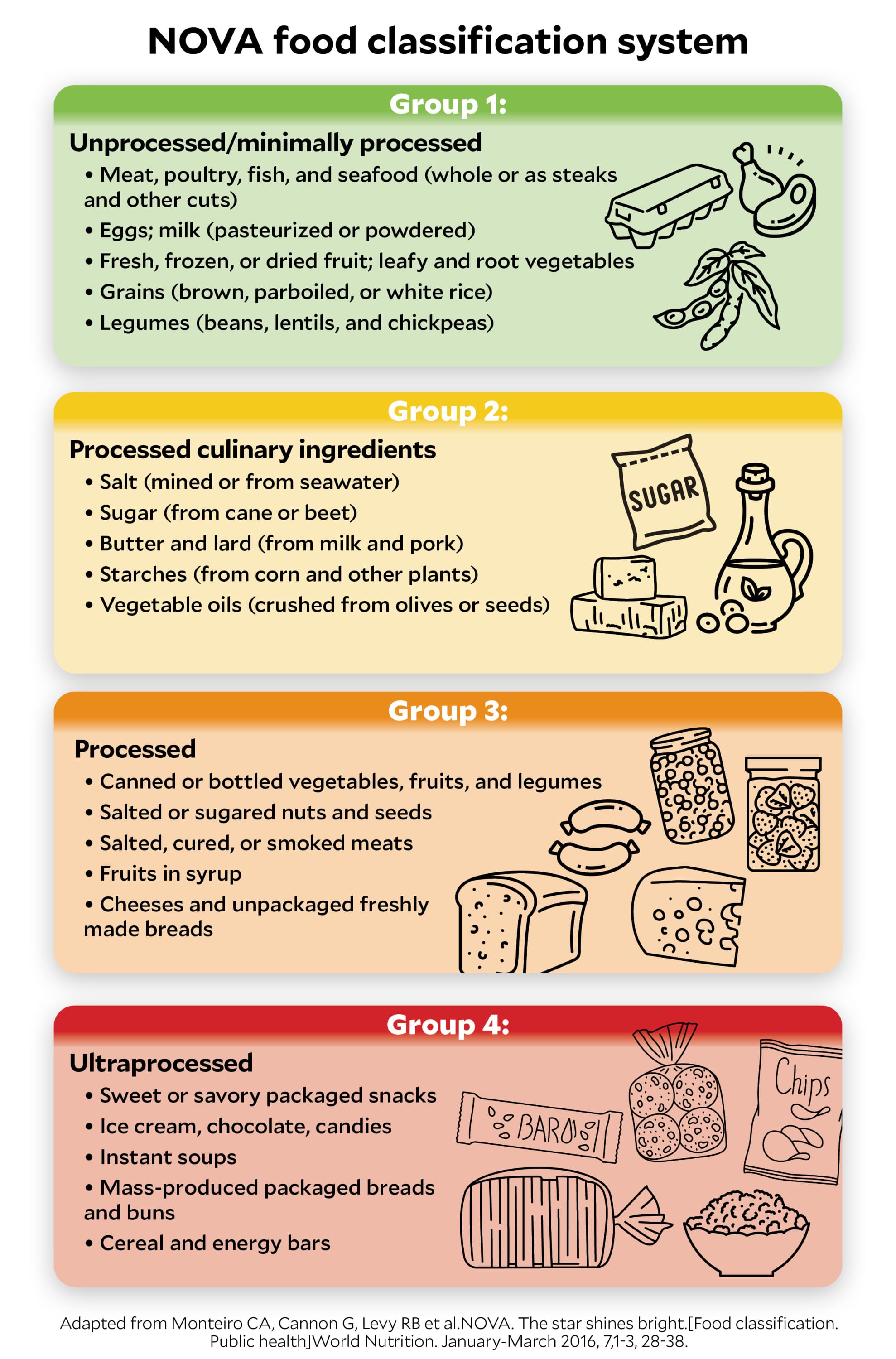
The studies in the review relied on a widely used classification system called NOVA that was developed by academic researchers in Brazil and breaks foods into four categories: unprocessed or minimally processed; processed culinary ingredients; processed; and ultraprocessed. (Examples of these foods appear below.)
The NOVA system, created in 2009, is recognized by the World Health Organization (WHO) and other groups, but not by the United States Department of Agriculture (USDA). It is hard to gain consensus on how to classify different types of processed foods, and there is debate among public policy experts, nutritionists, and the food industry on this topic.
Avlin Imaeda, MD, a gastroenterologist in Yale Medicine’s Metabolic Health & Weight Loss Program, says she talks to her patients about ultraprocessed foods—items that have “industrial formulations, chemicals, refined oils, fats, starches, and proteins,” which make them last longer and are highly palatable, or pleasant-tasting.
“That makes people eat more of them, and they are more calorie-dense, meaning people are consuming more calories even when they are eating smaller amounts of food,” she says.
Dr. Imaeda says she isn’t surprised by the review findings, but notes that the incidence rates of the related health conditions are small. “One issue with the studies they looked at is that the relative risks are not very high. They are 1.1-fold to 1.5-fold increases. However, if you are talking about a serious health problem, such as a heart attack, a 1.5-fold increase is still a lot,” she says. “Many of these studies are also not of the highest quality, which is, in part, because those are difficult to do. There are studies where they surveyed patients, everything from asking them to report what they consumed the previous day to asking them how often they eat certain foods, as opposed to a randomized clinical trial, where the diet is controlled by researchers.”
Plus, most of the foods people eat are ultraprocessed, as the CDC data shows.
“If everyone is eating lots of ultraprocessed foods, researchers don’t have a baseline group of people who don’t eat them to compare them to,” she says. “Plus, how many UPFs have a direct risk of these medical conditions versus how many of them are related to obesity? We know that obesity raises your risk of diabetes, cardiovascular disease, and various cancers.”
Below, we talk more with Dr. Imaeda about ultraprocessed foods and what the recent review reveals about their possible health effects.
What are ultraprocessed foods?
To understand what ultraprocessed foods are, it helps to understand how NOVA classifies foods. Those groups are as follows:
Group 1: Unprocessed or minimally processed foods.
Unprocessed, or “natural,” foods are obtained directly from plants or animals and do not undergo any alteration. Minimally processed foods are natural foods that have been cleaned, had inedible or unwanted parts removed, or have been ground, dried, fermented, pasteurized, frozen, or gone through other processes that subtract part of the food. No oil, fat, sugar, salt, or other substances have been added to foods in this category.
Examples include fresh or pasteurized fruit or vegetable juices with no added sugar or other substances; eggs; dried fruits; lentils, chickpeas, and beans; nuts; fresh and dried herbs and spices; fresh or pasteurized milk and yogurt without sugar; fresh or frozen meat, poultry, and seafood.
Group 2: Processed culinary ingredients
These are products extracted from natural foods using processes including pressing, grinding, crushing, pulverizing, and refining. They are used in homes and restaurants to season and cook food.
Examples include oils made from seeds, nuts, and fruits (olive oil, corn oil, sunflower oil); white, brown, and other types of sugar and molasses from cane or beets; honey; maple syrup; butter; lard; and refined or coarse salt.
(The use of processed culinary ingredients does not make meals nutritionally unbalanced as long as they are used in moderation in food preparation for natural or minimally processed foods.)
Group 3: Processed foods
These are foods from Group 1 that are made outside the home with salt, sugar, oil, or substances from Group 2 added to preserve them or make them more palatable. These items are derived directly from food and are recognized versions of the original food. Most processed foods have two or three ingredients.
Examples include freshly made cheeses; bacon and beef jerky; salted or sugared nuts or seeds; canned or bottled legumes or vegetables; unpackaged, freshly made breads; tomato extract, pastes, or concentrates (with salt and/or sugar); and fruits in sugar syrup.
Group 4: Ultraprocessed foods
These are industrial formulations made mostly or completely from substances (oil, fat, sugar, starch, and protein) extracted from food or derived from hydrogenated fats or modified starches. They can also be synthesized in laboratories with flavor enhancers, colors, and additives to make them highly palatable. These typically have five or more (usually many more) ingredients.
Examples include sweetened and flavored yogurts; breakfast cereals and bars; cola, energy, and sports drinks; pastries, cakes, cookies, and cake mixes; instant soups; ice cream and frozen desserts; packaged breads, hamburger, and hot dog buns; and pre-prepared pizzas, pasta, hamburgers, sausages, chicken nuggets, and fish sticks.
Group 1 foods are a small proportion of or even absent from ultraprocessed products.
The authors of the BMJ study note that the NOVA classification system for UPFs could be improved as it is complex, and some items may be misclassified.
How do ultraprocessed foods affect your health?
While it is hard to definitively say how and why ultraprocessed foods can lead to health problems, the BMJ researchers have theories. For example, in the review, researchers say ultraprocessed foods might replace more nutritious meal options, including fresh fruits and vegetables.
A diet composed mainly of ultraprocessed foods also exposes people to unhealthy additives and increases the risk of chronic inflammatory diseases, they add.
“A growing body of data shows instances of exposure to combinations of multiple additives, which may have potential ‘cocktail effects’ with greater implications for human health than exposure to a single additive,” the review authors say. “Finally, ultraprocessed foods can contain contaminants with health implications that migrate from packaging materials, such as bisphenols, microplastics, mineral oils, and phthalates.”
What are some highlights from the studies in the review?
Many of the studies of ultraprocessed foods examined in the BMJ review were based on surveys and other less rigorous methods, but there was one high-quality randomized controlled study, Dr. Imaeda notes.
This study, published in 2019, involved 20 healthy, overweight adults staying in a medical facility. Participants received either an ultraprocessed or unprocessed diet for 14 days and then switched to the other type for an additional two weeks. They were given three meals a day and told to eat as much or as little as they wanted within 60 minutes. The meals were matched for total calories, fat, carbohydrates, protein, fiber, sugars, and sodium. In one arm of the study, 83.5% of calories came from ultraprocessed foods; in the other arm, 83.3% came from unprocessed foods.
Study participants in the UPF group consumed 500 more calories per day than those on the unprocessed diet. The UPF group gained an average of two pounds, and the unprocessed group lost two pounds during the two-week study period.
“All of these findings were pretty significant,” Dr. Imaeda says. “They also found that people eating ultraprocessed foods were eating it faster. We know that if you absorb calories quickly, it lights up the reward center in the brain. Plus, these foods are more calorie-dense.”
How can you identify ultraprocessed foods?
According to a 2019 article published in Public Health Nutrition, one practical way to identify an ultraprocessed product is to see if its list of ingredients contains at least one item on the NOVA ultraprocessed food group list.
This group includes either food substances never or rarely used in kitchens (such as high-fructose corn syrup, hydrogenated or interesterified oils, and hydrolyzed proteins) or classes of additives designed to make the final product palatable or more appealing (such as flavors, flavor enhancers, colors, emulsifiers, emulsifying salts, sweeteners, thickeners, and anti-foaming, bulking, carbonating, foaming, gelling, and glazing agents).
“I would say that if the package has multiple ingredients and you can't identify some of them, it’s probably best to avoid it,” Dr. Imaeda says.
What can be done about ultraprocessed foods?
While it’s wise for people to know more about ultraprocessed foods and their possible negative effects, it’s important to remember that foods in some of the other NOVA categories carry risks, too. For example, red meat may not be processed, but it is linked to an increased risk of cardiovascular disease, diabetes, and certain cancers.
And while some foods, such as homemade chocolate chip cookies, may contain minimally processed ingredients, that doesn’t mean they are healthy or that you should eat a lot of them, Dr. Imaeda cautions.
Rather, Dr. Imaeda tells patients to think about moderation.
“Even if you go to a bakery or local market, you might find high-fructose corn syrup in breads. While that isn’t ideal, that doesn’t mean everyone needs to make their own bread and pasta at home,” she says. “But because we don’t fully understand the impact processed foods and added chemicals can have on our bodies, we should be wary of various chemicals and artificial sweeteners. We know they impact the brain and its reward system. If you have a sweet tooth, you might be reaching for those foods more.”
However, Dr. Imaeda acknowledges that eating healthy foods is not easy as they are more expensive and less convenient than many processed and ultraprocessed foods.
“I don’t know what the right answer is. I think there are ways to encourage people to eat healthier foods, but we need to ensure that people who have food insecurity [limited or uncertain access to adequate food] can afford them and make it easy for them to obtain. Plus, we need to educate people and make healthy foods available in daycare facilities and schools,” she says. “We want to be careful about not making it harder for people to get food in general.”

