Our Pandemic Year—A COVID-19 Timeline
On March 11, 2020, the World Health Organization (WHO) declared COVID-19, the disease caused by the SARS-CoV-2, a pandemic. The announcement followed a rising sense of alarm in the preceding months over a new, potentially lethal virus that was swiftly spreading around the world. A year later, we look back on one of the most challenging periods in recent memory.
It has been an emotional time marked by startling daily counts of new cases and deaths that multiplied rapidly. More than 100 million people around the world have been infected by COVID-19 and more than 2.5 million people have died of the disease. Many of us mourned loved ones in the last year, and the grief, along with isolation to prevent infections, took a toll on our mental health. Burgeoning caseloads overwhelmed hospitals, while health care workers became heroes, putting in long, harrowing hours, often (in those early days) without sufficient supplies, to care for patients with COVID-19.
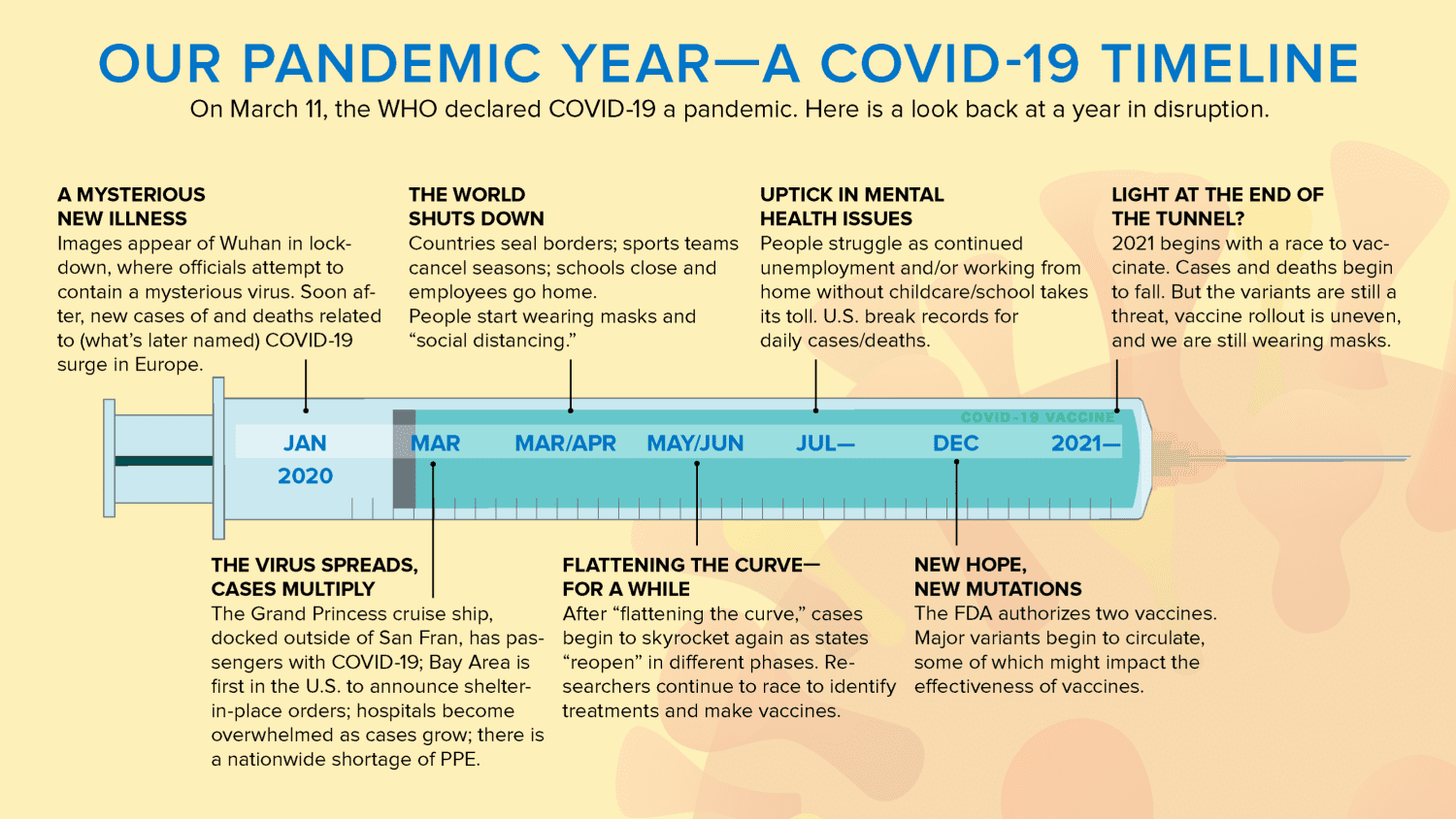
Here is a month-by-month look at our pandemic year.
2020
January: A scientist in China confirms that a mysterious new pneumonia-like illness identified in Wuhan, China, in December 2019, can be transmitted from human to human. Two days later, China puts Wuhan under strict lockdown. Meanwhile, on the other side of the globe, the U.S. sees its first case of the disease, later named COVID-19. The patient is a resident of Washington state who had traveled to Wuhan. The Trump Administration declares a public health emergency.
February: Cases of COVID-19 begin to multiply around the world. Countries are restricting travel to contain the virus.
March: The WHO characterizes COVID-19 as a pandemic. In the U.S., the Grand Princess cruise ship is held at sea off the coast of California after 21 of the 3,500 people aboard test positive for the virus. California also becomes the first state to order all residents to stay home with the exceptions of going to an essential job or shopping for essential needs. As cases grow, hospitals become overwhelmed, and there is a nationwide shortage of personal protective equipment (PPE). In Italy, there is a moment of solidarity when people in quarantine sing from their balconies, starting a trend that sweeps across Europe.
April: As cases continue to surge, countries keep their borders sealed. Businesses shut down (leading to massive job losses), schools close, sporting events cancel, and college students go home. People start wearing masks and practicing “social distancing.”
May: Experts focus on “flattening the curve,” meaning that if you use a graph to map the number of COVID-19 cases over time, you would ideally start to see a flattened line representing a reduction of cases. After months in lockdown, states slowly begin a “phased reopening,” based on criteria outlined by the Trump Administration, in coordination with state, county, and local officials. Meanwhile, scientists across the globe are in a race to understand the disease, find treatments and solutions, and develop vaccines.
June: Efforts to reopen the economy leads to new cases, and the curve is not flattening. Experts point to the dangers of large gatherings and use terms like “clusters” and “super-spreader events.”
July: The pandemic is causing an uptick in mental health issues as job losses continue to soar, parents juggle working at home with caring for or homeschooling children, and young adults grow frustrated by isolation from friends and limited job prospects. Officials debate the best scenarios for allowing children to safely return to school in the fall.
August: The first documented case of reinfection is reported in Hong Kong. On a broader scale, COVID-19 is now the third leading cause of death in the U.S. (after heart disease and cancer).
September: The school year opens with a mix of plans to keep children and teachers safe, ranging from in-person classes to remote schooling to hybrid models. Meanwhile, the WHO recommends steroids to treat severely and critically ill patients, but not to those with mild disease. The Centers for Disease Control and Prevention (CDC) reports that people who had recently tested positive were about twice as likely to have reported dining at a restaurant than were those with negative test results.
October: President Trump tests positive for COVID-19 after a gathering in the White House Rose Garden where multiple people were also thought to have been infected. Meanwhile, the Food and Drug Administration (FDA) grants full approval to a drug called remdesivir for treatment of COVID-19.
November: Cases rise again as cold weather drives more people indoors—the U.S. begins to break records for daily cases/deaths. Many officials around the country bring plans for reopening to a halt. As the holidays approach, the CDC urges Americans to stay home, limit the size of their gatherings, and avoid mixing with people who don’t live in their household.
December: The FDA grants Pfizer-BioNTech the first Emergency Use Authorization (EUA) for an mRNA vaccine, a new type of vaccine that has proven to be highly effective against COVID-19. A week later, it grants another EUA to Moderna, also for an mRNA vaccine. But, as vaccinations begin, major variants of the virus are beginning to circulate. The UK reports that a new variant of the virus, called B.1.1.7, could be more contagious. By the end of the month, B.1.1.7 is detected in the U.S.
2021
January: In the U.S., the number of cases and deaths begins to fall. But more variants are spreading, including one first identified in South Africa called B.1.351, which is reported in the U.S. by the end of the month. Around the world, the race is on to vaccinate as many people as possible in time to slow the spread of the variants. Researchers work to understand how deadly or contagious variants are compared to the original virus.
February: There is not enough vaccine supply to meet the demand. But the Biden Administration expects the addition of a third option (by Johnson & Johnson) to make vaccines more available to everyone. Meanwhile, companies are working to tweak their products to make distribution easier and to control new variants. So, while there may be hope that the end is in sight for the pandemic, it’s highly probable that we will still be wearing masks and taking other precautions for some time to come.